



How to Choose an EV Charger Installer in Pittsburgh: 7 Checks
Choose an EV charger installer in Pittsburgh the way you'd choose anyone who is going to open your electrical panel: verify the Pennsylvania home improvement registration, confirm the job will be permitted and inspected, and insist on a load calculation before anyone quotes a circuit. Then look at how they handle the local details: Duquesne Light, a 1950s brick house with a 100 amp panel, a detached garage at the top of a steep driveway. The charger brand comes last. Our EV charger installation in Pittsburgh page explains how we handle each of these; this post is about what to ask any installer, including us.
Short answer: A good EV charger installer in Pittsburgh is a registered, insured electrical contractor who pulls the permit, sizes the circuit from a real load calculation, coordinates with Duquesne Light when the service needs work, and puts a workmanship warranty in writing.
What "EV charger installation near me" actually shows you
Search for EV charger installation near me and you'll get three kinds of results mixed together.
- Directories. Review ranked lists. Worth reading, but a star rating says nothing about permits or insurance.
- Installer networks. Charger makers and third party networks assign a local electrician to your order. The listing confirms product training, not who will show up or whether that company is registered in Pennsylvania.
- Local electrical contractors. Companies with their own trucks, their own license numbers, and a reputation in Allegheny County to protect.
None of these is automatically bad. The results just don't do the vetting. The seven checks below do.
Check 1: Pennsylvania registration and the local license
Pennsylvania has no statewide electrician license, which surprises a lot of homeowners. What the state requires is registration under the Home Improvement Consumer Protection Act. Every home improvement contractor carries a number that starts with "PA" followed by digits, and you can look it up in a minute on the Attorney General's contractor search. Ours is PA-032900.
Be clear about what that number means. Registration proves the contractor filed with the state and carries the required insurance, and it gives you the written contract protections in the Act. It is not a competency test; the Attorney General's own site says registration is not an endorsement. The competency piece is local. The City of Pittsburgh licenses electrical contractors through Permits, Licenses and Inspections, and most boroughs and townships require contractor registration before issuing a permit. Ask which one the installer holds for your address.
Insurance is the other half of this check. Ask for a certificate of insurance showing general liability coverage in force; a contractor who is actually insured can produce one the same day. We're fully insured, and every technician on our crews passes a background check and monthly third party drug testing, which matters when someone is working alone in your basement.
Also ask who physically does the work. If the company subcontracts, the subcontractor should be just as easy to verify.
Check 2: Will the job be permitted and inspected?
A new 240 volt circuit for an EV charger is permit work everywhere in our service area. Inside city limits the electrical permit goes through the City of Pittsburgh's PLI office. Outside the city it goes through the borough or township, which usually hands the inspection to a third party agency. Allegheny County itself doesn't issue electrical permits, so an installer who says "the county doesn't require one" hasn't done much work here.
The installer should pull the permit in the company's name. An offer to skip it is the clearest red flag on this list: an unpermitted circuit can complicate an insurance claim, shows up at resale when the buyer's inspector asks for the sticker, and nobody independent ever checked the work.
The inspector works from the National Electrical Code, published by NFPA as NFPA 70. Article 625 covers electric vehicle supply equipment. Here is what the inspection looks at.
| What the inspector checks | Where the rule lives | What it means for you |
|---|---|---|
| Dedicated circuit, no other outlets | NEC 625.40 | The charger gets its own breaker. No sharing with the dryer or garage lights. |
| Breaker and wire at 125 percent of charger output | NEC 625.41 | A 48 amp charger needs a 60 amp circuit. A 40 amp charger needs a 50 amp circuit. |
| GFCI on a 240 volt garage receptacle | NEC 210.8(A) | A plug in install in a garage needs GFCI protection, one reason hardwiring has become the cleaner choice. |
| Working space at the panel | NEC 110.26 | Roughly 30 inches wide and 36 inches deep, kept clear. |
You need an installer who can explain that table without looking it up, and who schedules the inspection as part of the job.
Check 3: A load calculation before a quote
This is the check most homeowners skip, and the one that separates an EV charger installer from someone who hangs boxes on walls. A Level 2 charger is usually the largest single load you'll ever add to a house, so the installer needs to know what else the panel is carrying before naming a circuit size.
Pittsburgh's housing stock makes this matter. Much of the city's housing was built between the 1920s and the 1960s, with brick exteriors, plaster walls and a service sized for a gas furnace, a refrigerator and some lights. Many still have 100 amp panels; some still have 60 amp fuse boxes. Those houses have since picked up central air, an electric dryer and sometimes a heat pump. Add a 48 amp charger and the math stops working.
The code gives two ways to do this. NEC 220.87 lets an electrician use the home's actual demand history or a metered reading to establish the existing load, then add the charger. The alternative is a full calculation from the appliances and square footage. Either way, the installer should look at the panel and show you the number. A circuit size quoted over the phone is a guess.
If the panel can't take a 60 amp circuit, you still have options: a 40 or 32 amp charger, a unit with built in load management, a sub-panel, or a service upgrade. We sorted those out in Can Your Pittsburgh Home Handle an EV Charger?
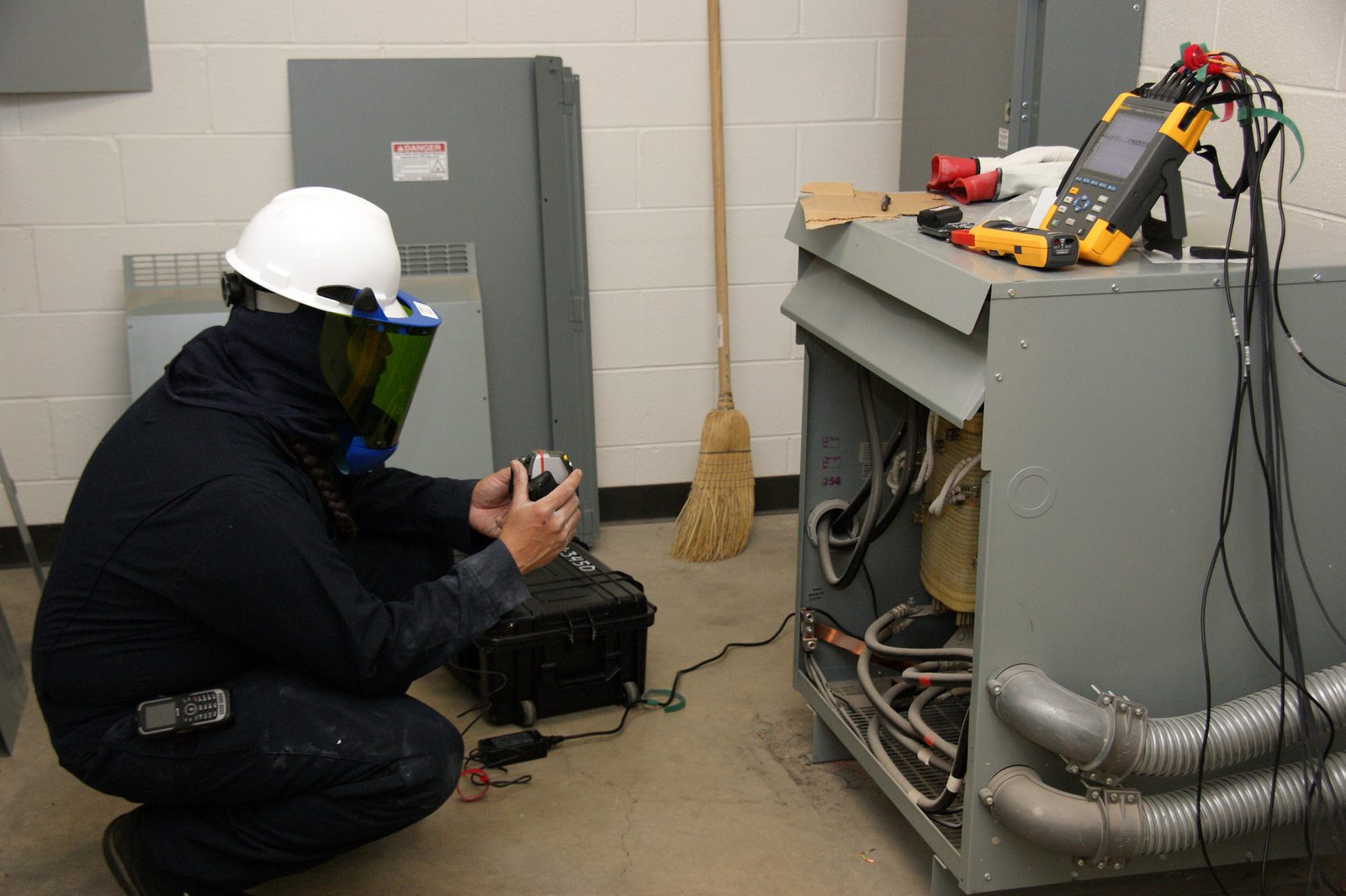
A clamp meter reading on the service conductors shows what the house actually draws, which is more useful than the number printed on the main breaker.
Photo: NAVFAC, CC BY 2.0, via Wikimedia Commons
Check 4: Duquesne Light, the meter and the service
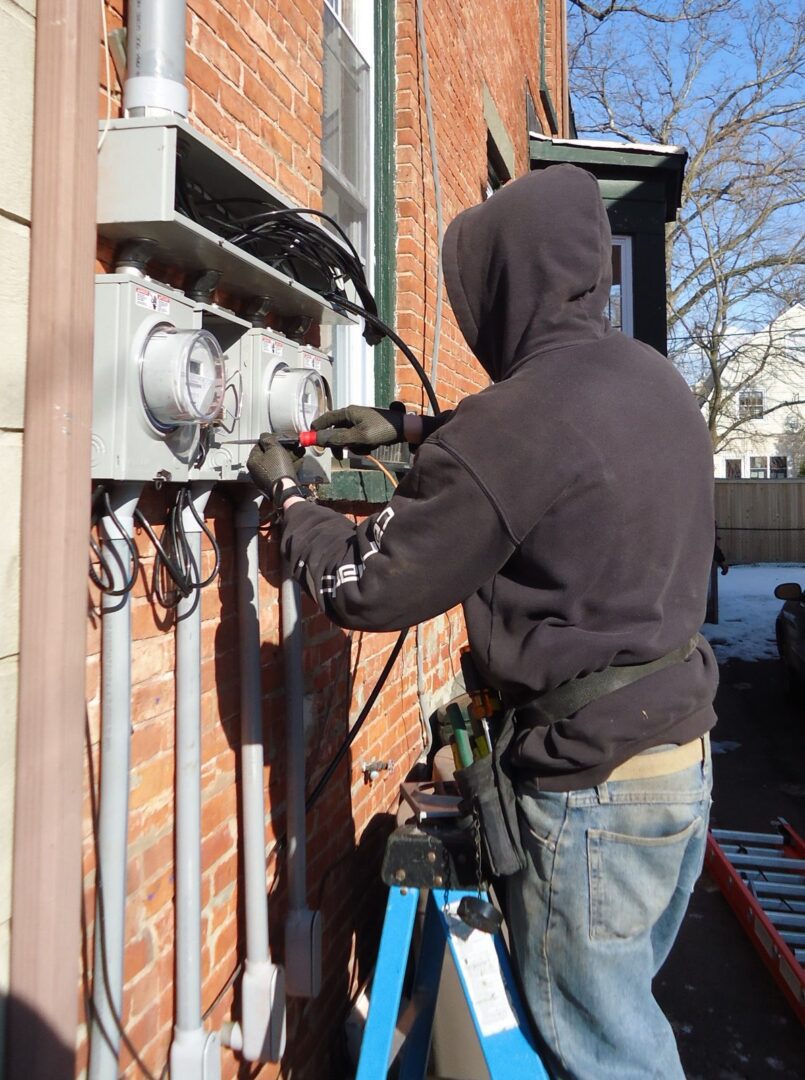
When the load calculation says the service has to go from 100 to 200 amps, the job changes. A service upgrade means a new meter socket, often a new mast and service entrance cable, a new panel, and a scheduled disconnect and reconnect by the utility. For nearly all of the Pittsburgh area that utility is Duquesne Light; a few outlying homes at the edges of our service area are on West Penn Power.
Ask the installer who calls the utility. The right answer is "we do." We handle the permit, the Duquesne Light coordination and the inspection on every panel and service job.
Two local wrinkles belong in this conversation. The first is the detached garage. A lot of Pittsburgh garages sit off an alley or at the top or bottom of a steep lot, with no power at all or one 15 amp circuit run from the basement decades ago. A Level 2 charger out there means trenching, conduit and usually a sub-panel, and the installer should walk the route before quoting. We covered that in Installing an EV Charger in a Detached Garage.
The second is winter. A charger on an exterior wall has to be rated for outdoors, mounted so the cable doesn't sit in slush, and sealed against water.
The meter socket and mast belong to the homeowner, while the utility owns the line feeding them, which is why a service upgrade has to be scheduled with the power company.
Check 5: Hardwired or plug in, and who picks the charger
A good installer will tell you whether they recommend a hardwired charger or a NEMA 14-50 receptacle, and why. Hardwiring supports the full 48 amp output that many wall units offer, avoids GFCI nuisance tripping in a garage, and is usually the better choice for an outdoor mount. A receptacle lets you unplug and take the charger with you. The tradeoffs are in NEMA 14-50 Outlet vs. Hardwired.
On the charger itself, the installer should be comfortable with whatever you bought or plan to buy, whether a Tesla Wall Connector, a J1772 unit from ChargePoint, Emporia or Wallbox, or a universal unit with both plugs, and should say so when your pick doesn't fit the job. Our technicians are ASE certified EV charger installers, and we source materials direct from manufacturers, so we can supply the charger or install the one you own.
Check 6: The warranty, in writing
There are two warranties on an EV charger install. The manufacturer's covers the unit. The installer's workmanship warranty covers the circuit, the breaker, the terminations, the conduit and the mounting. If a breaker starts tripping in February, the manufacturer will tell you to call your electrician, so the workmanship warranty is the one you'll actually use.
Ask how long the workmanship warranty runs and whether it's written into the contract. We put a lifetime workmanship warranty on our installations, and the terms are on our warranty page for anyone to read. Ask for the written contract itself, too. Pennsylvania's Home Improvement Consumer Protection Act requires one, with the contractor's registration number, a description of the work, and start and completion dates. A contractor who wants to work from a text message has already told you how a warranty call will go.
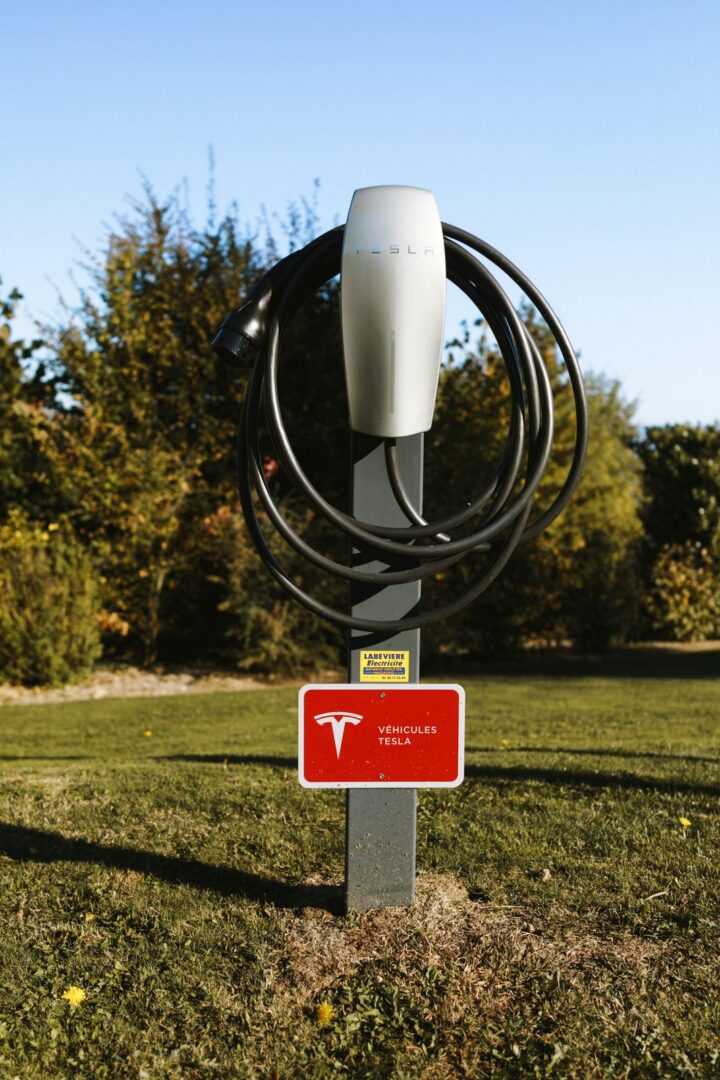
A finished Level 2 install: charger mounted at a usable height, cable managed, and a dedicated breaker on the other end of the run.
Check 7: Red flags that end the conversation
- Offers to skip the permit, or says the county doesn't require one.
- Quotes a circuit size over the phone without asking what's on your panel.
- Can't produce a PA registration number, a municipal license, or a certificate of insurance on request.
- No written contract, or a contract with no warranty language.
Once an installer clears all seven, what's left is scheduling and which charger goes on the wall. That's the easy part.
Frequently Asked Questions
Can a normal electrician install an EV charger?
Yes. A Level 2 charger is a 240 volt circuit that any qualified electrical contractor can run. What you want on top of that is familiarity with NEC Article 625, experience with load calculations on older Pittsburgh panels, and a habit of pulling the permit. Installer networks add product training; they don't replace a registered local contractor.
How much does it cost to install an EV charger at home?
It depends on the distance from the panel to the charger, whether the panel has room and capacity for a 50 or 60 amp circuit, whether the run is indoors or trenched to a detached garage, and whether a service upgrade is needed. Those four factors drive almost everything, and a free estimate gives you the actual number for your house.
Do I need a permit to install an EV charger in Pittsburgh?
Yes. A new 240 volt circuit is permit work inside the city through PLI, and in the surrounding boroughs and townships through their building offices, which typically use a third party inspection agency. Allegheny County does not issue electrical permits itself. Your installer should pull the permit and schedule the inspection.
Does Duquesne Light have to be involved?
Only when the service itself changes. Adding a charger circuit to a panel with enough capacity doesn't involve the utility. Upgrading from 100 to 200 amps does, because the meter has to be pulled and the service reconnected on the utility's schedule. We coordinate that with Duquesne Light, or West Penn Power for the few homes it serves in our area.
How do I check if an EV charger installer is registered in Pennsylvania?
Search the Attorney General's home improvement contractor database at hicsearch.attorneygeneral.gov by business name or registration number. The number should appear on the contractor's estimate and contract. Then ask for the municipal license or registration for your borough, township, or the City of Pittsburgh.
Ready to compare us against this list? Request a free estimate and we'll look at your panel, your garage and your charger before we quote a number, or call 1-888-681-WIRE (9473) any time.
Related Reading
Need an electrician in Pittsburgh?
Honest diagnosis, licensed work, clear pricing. Call us or schedule a visit online.